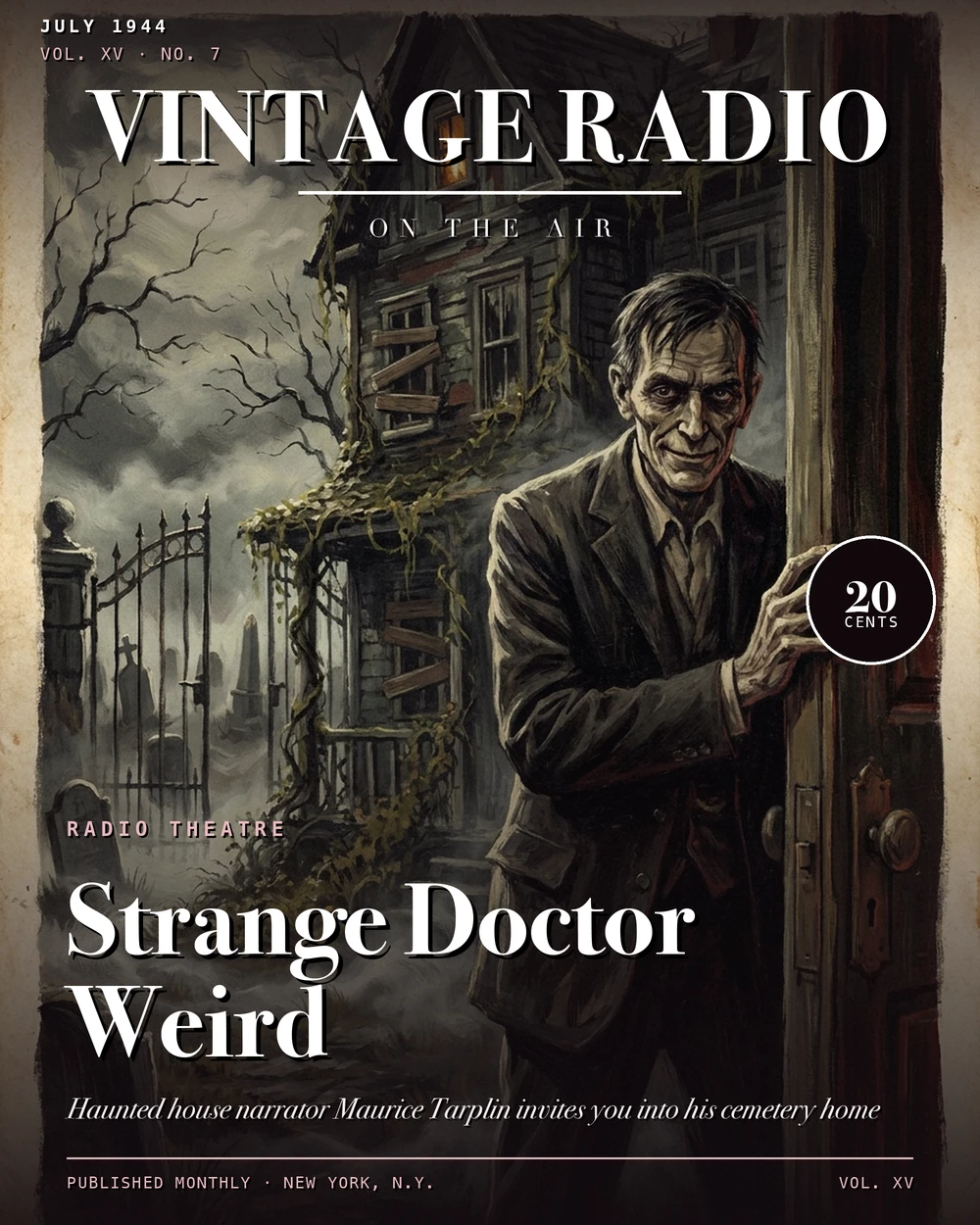
Strange Doctor Weird
The Poor Man's Mysterious Traveler
Strange Doctor Weird arrived on Mutual in November 1944 essentially as a scaled-down version of an already-running show. Writer Robert A. Arthur and narrator Maurice Tarplin were both working on The Mysterious Traveler at the same time, and the new program drew on the same creative stable — same writer, same voice, same network, same pool of New York radio actors, and in many cases the very same scripts, condensed from half-hour originals down to fifteen minutes. The result was, by most accounts, a slighter show than its parent, with the compressed format doing real damage to the pacing and atmosphere that made The Mysterious Traveler work. The quality gap was a direct consequence of the shorter running time, not a sign that anyone was phoning it in.
What the show did keep was Tarplin. His voice — described by contemporaries as "eerily sardonic" — carried much of the weight. Each episode opened with the announcement "Adam's Hats presents The Strange Dr. Weird," and from there Tarplin took over, introducing stories of supernatural horror with the same tone he used on The Mysterious Traveler: what one radio historian called "good-natured menace, the kind of mischievous malevolence inspired by The Whistler or Raymond of Inner Sanctum Mysteries." In a fifteen-minute format where there wasn't much room for story to breathe, that voice was the main event.
The show ran on Tuesdays at 7:15 PM for exactly twenty-nine episodes, from November 7, 1944 to May 15, 1945, with Adam Hats as the sole sponsor. Adam Hats also got some of the more distinctive commercial real estate on the program: the sponsor segments featured direct interaction between the announcer and Dr. Weird himself, something listeners apparently found entertaining, if a little odd.
The Closing That Defined the Character
Whatever its limitations in story depth, Strange Doctor Weird knew how to close an episode. The sign-off became the show's most memorable feature — a piece of atmospheric writing that gave the character a home and a personality in just a few sentences. At the end of each broadcast, Tarplin delivered the line: "Oh, you have to leave now—too bad! But perhaps you'll drop in on me again soon. I'm always home. Just look for the house on the other side of the cemetery—the house of Dr. Weird!"
That closing mirrored the style used on The Mysterious Traveler, where the narrator's farewell was as carefully crafted as anything in the episode itself. The image of a house on the far side of a cemetery, always occupied, always waiting, was exactly the kind of detail that lingered. It gave the show a sense of place even without a recurring cast or ongoing storyline. Each week was a self-contained grisly tale, but Dr. Weird's house was always there at the end, a fixed point in a collection of otherwise disconnected horrors.
Organ music accompanied Tarplin's introductions and closings, lending the same atmospheric sound design that characterized The Mysterious Traveler. The production was directed and produced by Jock McGregor throughout the run, and the episode titles tell their own story about what kind of territory the show covered: "The House Where Death Lived," "The Man Who Talked with Death," "The Voice of Death," "He Woke up Dead," "Revenge from the Grave," "The Ghost Ship," "Murder, One Million BC." The supernatural thrillers from the Mysterious Traveler archive were the ones recycled here; the murder mystery material went to The Sealed Book, a separate companion program that ran the same scripts at full half-hour length.
Maurice Tarplin
Maurice Tarplin was born April 1, 1911, in Boston, Massachusetts, and by the mid-1940s he was one of the busiest dramatic voices on Mutual. He had attended Phillips Exeter Academy, the College of William & Mary — where he played on the school's championship ice hockey squad — and later Harvard, before making his way into radio. By 1942 he was already playing Agatha Christie's Hercule Poirot on Murder Clinic over Mutual, and when The Mysterious Traveler launched in December 1943, Arthur and his partner David Kogan cast him as the narrator.
Strange Doctor Weird ran from November 1944 through May 1945, and even before it ended Tarplin had moved on to Inspector Farraday on Boston Blackie, which started on Mutual on April 1, 1945, and ran through 1950. Over the course of his career he appeared on The Shadow, Suspense, Nick Carter Master Detective, Casey Crime Photographer, The New Adventures of Sherlock Holmes, Counterspy, Yours Truly, Johnny Dollar, X-Minus One, Hallmark Playhouse, Famous Jury Trials, The Cavalcade of America, and Mr. and Mrs. North, among many others. He also portrayed Winston Churchill on The March of Time and played Barnie Belzer on Myrt and Marge. On the television side, he made his debut in 1951 on Shadow of the Cloak and later appeared in Lamp Unto My Feet, Danger, I Spy, and Naked City. In his later years he did voiceover work for television commercials and provided translations for the English-language soundtracks of foreign films. He died May 12, 1975, in Chappaqua, New York, at sixty-four.
He also wrote fiction. His short story "Seven Casks of Death" appeared in the June 1948 issue of Dime Mystery Magazine — a small but telling detail about the kind of material that clearly interested him.
The Writer Behind the Show
Robert A. Arthur was born November 10, 1909, on Corregidor Island in the Philippines, where his father was stationed as an Army lieutenant. He met his writing partner David Kogan while both were taking a radio-writing class at Columbia University in 1940, and from 1942 to 1953 the two worked together as producers, directors, and writers for Mutual in New York. Their collaboration on The Mysterious Traveler, Strange Doctor Weird, and The Sealed Book earned them three Edgar Awards from the Mystery Writers of America: Best Radio Drama in 1950 for Murder by Experts, an outstanding achievement award in 1951 for their combined radio work, and Best Radio Drama in 1953 for The Mysterious Traveler itself.
In practice, each script in their shared credits was written solo by one or the other — Martin Grams compared their working method to that of Lennon and McCartney. Arthur also wrote for pulp magazines under a considerable string of pseudonyms, including Robert Forbes, John West, Anthony Morton, Andrew Fell, Jay Norman, Joan Vatsek, and A.A. Fleming, among others. After radio wound down, he became best known as the creator and primary author of The Three Investigators, a popular series of young adult mystery novels, and as an editor of Alfred Hitchcock anthology collections. He died May 2, 1969, in Philadelphia, at fifty-nine. The co-writing credit on Strange Doctor Weird is sometimes shared with Kogan, though most sources credit Arthur alone.
What Survived
One of the stranger facts about Strange Doctor Weird relative to its parent show is the survival rate. The Mysterious Traveler aired 370 episodes between December 1943 and September 1952 and won the Edgar Award for Best Radio Drama — but only around seventy to seventy-five of those episodes survive today. Strange Doctor Weird, the shorter and by most accounts weaker show, survives in full. All twenty-nine episodes are extant, totaling roughly five hours and fifty-four minutes of audio — a complete set that fits on a single CD. The complete run has been certified as such.
There is a minor discrepancy in the historical record worth noting: at least one independent research source counts twenty-eight aired episodes rather than twenty-nine, though the weight of the documented evidence points to twenty-nine. Either way, what's there is everything there is — no gaps, no missing installments. For a show this minor in the scheme of 1940s radio, that's a notable piece of luck.